


Egon Schiele

The Austrian painter Egon Schiele lived only twenty-eight years. Yet in less than a decade, he created one of the most striking works of European art of the early 20th century. His paintings and drawings are immediately recognizable: they are characterized by sharp lines, unusual gestures, deformed proportions, intense gazes, empty space and strong psychological expression. Schiele did not idealize man. He was interested in the themes of life and death, sexuality, loneliness, the relationship between man and woman, motherhood and his own identity. However, cities and landscapes also occupied a significant place in his work. An important part of his life and artistic creation was Český Krumlov – his mother's hometown and the place where he lived and worked in 1911.
BIRTH IN TULLN
The Railway Child - full name Egon Leo Adolf Schiele was born on June 12, 1890 in Tulln an der Donau in Lower Austria, right in the building of the Tulln railway station, where his father Adolf Schiele worked as the stationmaster. The family had a service apartment there, so the railway was one of the first worlds that little Egon got to know. He spent the first years of his life here.

FAMILY
Egon was the only son of Adolf Schiele and Maria Schiele, née Soukupová. His father's family had long been connected to the railway. Adolf Schiele held the responsible position of stationmaster and represented an important authority for the family. On the other hand, his mother, Maria, brought a connection to the Czech environment into Schiele's life. She was born in Český Krumlov and came from the Soukup family. Egon had three sisters – Elvira, Melanie and Gertrude. The eldest, Elvira, died in 1893, when she was only ten years old. Egon was three years old at the time. From his earliest childhood, the family environment was marked not only by closeness, but also by illness and death – themes that later appeared prominently in his work.
FATHER
Egon had a close relationship with his father. However, in the last years of his life, Adolf Schiele's health deteriorated significantly. He suffered from syphilis, which gradually affected his physical and mental state. Adolf Schiele died at the turn of 1904 and 1905, when Egon was fourteen years old. For the adolescent Schiele, his father's death represented a major turning point in his life. Of course, it cannot be said that his later fascination with death arose solely as a result of this experience. Nevertheless, illness, loss and the awareness of transience entered his life very early. After his father's death, his uncle Leopold Czihaczek, a high-ranking railway official, took over guardianship of Egon and his younger sister Gertrude .


MOTHER
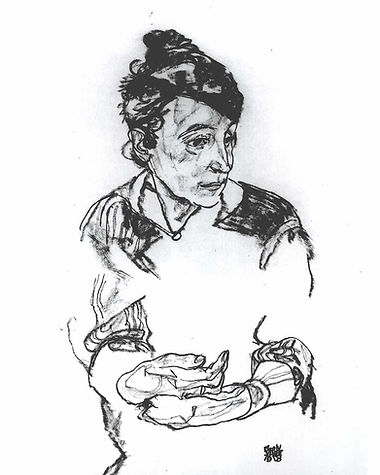
Schiele's mother, Marie Schiele, née Soukupová, came from Český Krumlov. It was through her that Schiele had a deep family connection to the town even before he began to work there. The relationship between mother and son was complex. Marie allowed Egon to pursue an artistic career and agreed to his studies in Vienna. However, the surviving letters also show conflicts, reproaches and a sense of mutual misunderstanding. Schiele also painted portraits of his mother. The theme of mother and child later appeared repeatedly in his work. However, motherhood is not a calm or sentimental image for him. It is often associated with anxiety, corporeality, birth and death.
SISTERS
Elvira, Melanie and Gerti Schiele - Elvira Schiele died as a child. Melanie Schiele was four years older than Egon and had her own artistic and fashion interests. Egon had the closest relationship with the youngest, Gertrude "Gerti" Schiele. Gerti had been his close companion since childhood and later became one of his models. Schiele drew and painted her during the period when he was creating his own artistic language. She later married Schiele's friend, the painter Anton Peschka.

ACADEMY
Schiele's artistic talent was evident very early on. Although he was not an exceptional student at school, his drawing skills were noticed by teachers and people around him. In 1906, at the age of just sixteen, he was accepted to the Academy of Fine Arts in Vienna. He studied with Professor Christian Griepenkerl, a representative of traditional academic painting. It was here that the conflict between Schiele's need for his own artistic freedom and the conservative system of teaching began to manifest itself. In 1909, he left the Academy and, together with other young artists, founded the Neukunstgruppe - New Art Group. He was nineteen years old.

GUSTAV KLIMT
One of the most important figures in Schiele's early career was Gustav Klimt. Schiele sought him out around 1907. Klimt was almost thirty years older and was already one of the most important Viennese artists at the time. He recognized the young Schiele's talent, supported him and helped him enter the environment of Viennese modernism, collectors and patrons. Schiele's early works bear a significant Klimt influence - flatness, ornamental composition and decorativeness. However, he very quickly began to find his own path. Around 1910, the ornament recedes, the body deforms, the line becomes sharp and nervous and there is almost empty space around the figures. Schiele ceased to be Klimt's follower and created his own, immediately recognizable style. Schiele's acquaintance with Wally Neuzil is probably also connected with Klimt. The exact circumstances are not reliably documented. According to tradition, however, Klimt was supposed to have recommended Wally as a model to the young Schiele. It is therefore often stated that Wally herself had previously been one of Klimt's models. However, this claim cannot be considered as clearly proven, and it is therefore more appropriate to speak of the probable mediation of the acquaintance through Klimt. Gustav Klimt died on February 6, 1918. The following day, February 7, 1918, Schiele came to the morgue of the Vienna General Hospital, where Klimt's body was laid to rest. He drew his former mentor there three times. This resulted in extremely impressive drawings of the dead Klimt. Schiele himself died just under nine months later.


THE BIRTH OF YOUR OWN STYLE
The year 1910 is one of the most crucial periods in Schiele's work. At the age of twenty, he created an artistic language that was radically different from the traditional portrait and nude. His figures are emaciated, twisted and often anatomically deformed. Hands and fingers acquire their own expressive language. The skin can have green, red, blue or ochre shades. Schiele was not interested in the perfect body, he was interested in the person beneath the surface. Fear, sexuality, desire, illness, self-confidence, shame, loneliness and death can be expressed in a single gesture. In addition, the empty background deprives the person of the environment and leaves them almost alone in front of the viewer.
SELF-PORTRAITS
Few artists have observed themselves with such intensity as Egon Schiele. He created an extraordinary number of self-portraits. However, he was not only interested in his own appearance, he became his own model and means of experiment. In the individual self-portraits, he is proud, sick, erotic, frightened, provocative and almost dead. He exaggerates cheekbones, eyes, hands, fingers and gestures. For Schiele, a self-portrait is therefore not just an answer to the question: What do I look like? It is above all a question: Who am I?
CESKY KRUMLOV
Český Krumlov was not a random artistic destination for Schiele. It was the birthplace of his mother Marie and a place connected to his own family past. He had been coming here more intensively since 1910. The old town, squeezed by the meander of the Vltava River, fascinated him so much that it became one of the most important motifs in his landscape work. However, Schiele did not paint Krumlov as a romantic postcard. He arranged the houses into strange organisms. The perspective is deformed, the roofs are pressed against each other and the human presence almost disappears. For him, the city appears as a living being – beautiful, old, vulnerable and sometimes almost dead.
GARDEN ATELIER
In 1911, Schiele decided to settle in Český Krumlov. Local high school student Willi Lidl found a garden house for him on a terraced slope above the Vltava River, helped negotiate its use and ensure the necessary modifications. The owner at the time, textile merchant Max Tschunk, allowed Schiele to use the house free of charge. Schiele lived there with his partner and model Wally Neuzil. He grew to love the house and the gardens. In its surroundings, he drew children, old women, retired soldiers and young models, and at the same time created paintings with Krumlov motifs. However, his way of life began to arouse opposition from the conservative part of the local population. They were provoked by his unmarried relationship with Wally and the fact that he drew nudes in his studio and young people met there. His attempt to settle in Krumlov therefore ended in 1911. However, the city did not disappear from his work.
WALLY WAS NOT USED
Walburga "Wally" Neuzil entered Schiele's life around 1911. She was approximately seventeen years old. The exact circumstances of their first meeting are not documented. According to tradition, Gustav Klimt played a certain role, who was supposed to recommend Wally to Schiele as a model. However, she very quickly ceased to be just one of his models. She became his partner, confidante and, over the next four years, one of the closest people in his life. She accompanied him to Český Krumlov and later to Neulengbach. She also stood by him during his arrest and imprisonment. Schiele repeatedly drew and painted her. Her most famous likeness was the Portrait of Wally Neuzil from 1912. Schiele created it as a counterpart to his Self-Portrait with a Cinchona.


NEULENGBACH
After leaving Český Krumlov, Schiele and Wally settled in Neulengbach near Vienna. Here, too, his studio was visited by young people and children from the area. In April 1912, Schiele was arrested. A number of legends later arose around this case, which is why it is important to distinguish between the individual charges. Schiele was investigated for the alleged kidnapping and sexual abuse of an underage girl. He was not convicted of these charges. The court punished him for erotic drawings that were accessible to minors in his studio. He spent a total of approximately 24 days in prison, mostly in pretrial detention. This experience had a strong impact on him and was also reflected in the drawings and letters from this period.
RETURN TO VIENNA
After the Neulengbach trial, Schiele returned to Vienna. In the autumn of 1912, he acquired a studio at Hietzinger Hauptstraße 101, which he used until the end of his life. His reputation was controversial, but his artistic status gradually grew. He exhibited in Vienna and abroad, and his works appeared in a number of important European cities. Schiele was no longer just a young provocateur. He was beginning to be considered one of the most outstanding artists of his generation.
The Harms family lived opposite Schiele's Vienna studio. Schiele became close to the sisters Edith and Adele Harms and gradually decided to live with Edith. For Wally, this meant the end of their relationship of several years. In the spring of 1915, he broke up with her. On June 17, 1915, he married Edith Harms. Just a few days later, he had to enter military service. Wally worked as a nurse during the war and died of scarlet fever in 1917 at the age of 23. S
WORLD WAR I
The First World War fundamentally changed Schiele's life. In 1915 he was drafted into the Austro-Hungarian army. He served in Prague and Jindřichův Hradec, among other places. Later he worked in administrative positions and in 1916 he worked in a camp for Russian prisoners of war in Mühling. He did not stop drawing even during his military service. He created a number of portraits of soldiers, officers and Russian prisoners of war. At the same time, his artistic language began to change. The fragmented lines of the early period gradually calmed down, the figures gained more volume and appeared more natural.
_-_(MeisterDrucke-1655.jpg)


MARRIAGE AND CHANGE OF WORK
His marriage to Edith and the experience of war gradually changed Schiele's life and work. In his early years, his work is dominated by often isolated figures and self-portraits. In his later work, couples, portraits and family themes increase. His lines are smoother, the human body gains volume and some portraits approach greater realism. Nevertheless, Schiele does not abandon his fundamental question: How close can two people really be? Even his loving couples often seem paradoxical. Their bodies touch, but they can remain psychologically separate.
Among Schiele's most impressive late works is the painting Family from 1918. It was originally created as a composition of a couple, but Schiele later transformed it into a painting of a man, a woman and a child. The man has Schiele's own features. The painting thus seems almost like an idea of the family he might have had. Edith was pregnant at the time of its creation. Later events gave the painting an extraordinarily tragic power. In the autumn of 1918, the Spanish flu pandemic hit Vienna. Edith was six months pregnant at the time. In October, she fell seriously ill. Schiele continued to draw her during her illness and tried to care for her. On October 28, 1918, Edith died. She was 25 years old. Their unborn child also died with her. Egon had already been infected.

DEATH OF EGON SCHIELE
Just three days after Edith, Egon Schiele also died on October 31, 1918. He was only 28 years old. After his death, photographs of Schiele on his deathbed were taken. On November 2, 1918, two days after his death, the young sculptor Gustinus Ambrosi removed the death mask from Schiele's face. A remarkable symbolic connection was thus created: on February 7, 1918, Schiele drew the dead Gustav Klimt. On October 31, 1918, he died alone. On November 2, 1918, the death mask of Egon Schiele was created. Two of the most important artists of Viennese modernism died within a single year.
Schiele's work is sometimes reduced to erotic nudes. However, its true meaning is much broader. The main theme of Schiele's work is human existence. The body can be young, erotic and full of life, but at the same time fragile, vulnerable, sick and mortal. Schiele questioned the traditional boundary between beauty and ugliness, he did not try to beautify a person. He showed him uncertain, lonely, longing, loving and dying. He was able to transfer the same intensity to trees, landscapes and cities.


EGON SCHIELE IN DATA
1890 – Born on June 12 in Tulln an der Donau
1893 – Sister Elvira died
1904/1905 – father Adolf dies 1906 – admitted to the Academy of Fine Arts in Vienna
1907 – meeting with Gustav Klimt
1909 – leaves the Academy and establishes the Neukunstgruppe1910 – creates his own radical artistic style and spends more time in Český Krumlov1911 – lives with Wally Neuzil in a garden studio in Český Krumlov
1912 – arrest and imprisonment in Neulengbach
1913–1914 – his international recognition grows
1915 – separation from Wally, marriage to Edith and entry into military service
1916 – service in a prisoner of war camp
1917 – Wally Neuzil diesFebruary 6
1918 – Gustav Klimt diesFebruary 7
1918 – Schiele draws a dead Klimt
1918 – great success at the 49th Vienna Secession exhibition
October 28, 1918 – Edith Schiele dies
October 31, 1918 – Egon Schiele dies
November 2, 1918 – Gustinus Ambrosi removes Schiele's death mask